Tuesday, 25 June 2019

Kalapas Dicopot karena Kebijakan Baca Quran, Praktisi Hukum: Presiden Harus Copot Yasonna


GELORA.CO - Direktur Lembaga Bantuan Hukum (LBH) Street Lawyer, Kamil Pasha mengaku tidak percaya atas berita Kepala Lembaga Pemasyarakatan (Kalapas) Polewali yang mensyaratkan salah satu warga binaan dibebaskan saat masa tahanan habis jika dapat membaca Alquran. Namun, menurut Kamil program tersebut sangat baik untuk memberantas buta huruf Alquran.

“Ini program yang baik. Konsep narapidana dengan warga binaan sudah beda, kalau dulu namanya penjara, sekarang Lembaga Pemasyarakatan,” kata Kamil, Selasa (25/6).

Kamil menyebutkan, salah satu upaya agar warga binaan di dalam Lapas bisa keluar dan diterima masyarakat yaitu melewati proses pembinaan, diantaranya pembinaan agama. Menurut dia, pengetahuan membaca Alquran merupakan salah satu wujud pembinaan agama.

“Saya juga belum lihat bentuk pemaksaannya, ada nggak contoh kasus konkritnya? Siapa nama warga binaan Lapas yang tidak bisa keluar setelah masa hukumannya habis gara-gara tidak mengikuti atau belum lulus program membaca Alquran,” ujarnya.

Maka itu, ia mendorong Menkumham transparan dalam penegakan hukum bagi warga Lapas. Pasalnya, banyak warga Lapas yang dapat keluar bebas ketika menjalani masa hukuman bahkan berhasil keluar Lapas dengan jumlah ratusan seperti di Rutan Lhoksukon, Aceh Utara beberapa waktu lalu.

“Ada juga yang tertangkap tangan oleh KPK dan juga Kalapas mengenai peraturan warga binaan kasus korupsi yang ingin berobat. Padahal itu hanya alasan saja,” ujar dia.

Ia menambahkan, program hapalan dan pemberantasan huruf al-Quran justru disambut baik oleh warga binaan seperi di Lapas Mojokerto, Jawa Timur. Karena itu, yang seharusnya diberhentikan dari jabatannya adalah Menkumham.

“Saran saya presiden copot Menkumham Yasonna Laoly. Banyak warga binaan kasus korupsi yang pura-pura berobat ke Rumah Sakit, padahal tidak. Nah, atas hal itu harusnya presiden mencopot (Yasonna) karena gagal menjalankan tugasnya,” ujar Kamil. [ns]

Amnesty International Temukan Pelanggaran HAM Serius oleh Aparat Saat Kerusuhan 21-22 Mei


GELORA.CO -  Amnesty International Indonesia temukan tindakan pelanggaran serius terhadap Hak Asasi Manusia (HAM) yang dilakukan oknum Brimob di Kampung Bali pada aksi 21-23 Mei 2019 lalu.

Peneliti Utama Amnesty International Indonesia, Papang Hidayat mengatakan, pihaknya mendapat 28 video dari publik, dan 9 video di antaranya telah melalui proses verifikasi oleh tim DVC (Digital Verification Corps) Amnesty International di Berlin.

Dari hasil investigasi yang dilakukan tim Amnesty International Indonesia, terdapat tiga temuan penyiksaan yang terjadi pada aksi 21-23 Mei.

Pertama, terjadi penyiksaan di Kampung Bali di mana sebuah video viral memperlihatkan aksi kekerasan dilakukan personel Brimob terhadap seorang pria. Tim Amnesty International Indonesia menegaskan telah melakukan verifikasi keaslian video dengan mewawancarai para saksi.

"Insiden Kampung Bali mengemuka ketika pada sehari setelah kejadian sebuah video viral di sosial media yang memperlihatkan anggota Brimob melakukan penyiksaan dan tindakan yang tidak manusiawi terhadap seseorang yang sudah tidak berdaya," ucap Palang Hidayat kepada awak media di Kantor Amnesty International Indonesia, Jakarta Pusat, Selasa (25/6).

Saat itu, terdapat lima orang yang mendapat penyiksaan serta perlakuan buruk oleh personel Brimob di sebuah lahan kosong Smart Service Parking di Kampung Bali.

"Kita datang setelah kejadian dan setelahnya kita mengidentifikasi paling sedikit ada 5 korban termasuk yang ada di video viral dan 4 korban lagi lainnya di kampung Bali pada saat bersamaan," paparnya.

Dari penuturan saksi, lanjut Palang, ada seorang yan sedang tidur dan ditangkap aparat. Dari fakta ini, ia menilai aparat Brimob tidak bisa memilah mana yang melakukan kekerasan dan mana yang tidak. 

"Ini tidak hanya di kampung Bali yang ditemukan organisasi HAM lainnya. Orang tidak boleh dilakukan kekerasan karena sudah tidak melawan," jelasnya.

Temuan kedua, terdapat penyiksaan dan perlakuan buruk yang terjadi di depan gedung Bawaslu. Kelima korban yang ditangkap di Kampung Bali diseret hingga depan Bawaslu dan dikumpulkan dengan orang lainnya yang telah ditangkap polisi. 

Di sana, setiap anggota Brimob melakukan pemukulan secara bergantian hingga dimasukkan ke dalam mobil tahanan.

Temuan ketiga, terdapat penyiksaan yang dilakukan aparat Brimob yang dilakukan di depan Fave Hotel dan di Jalan H. Agus Salim. Polisi disebut telah melakukan kekerasan yang tidak diperlukan ketika menangkap beberapa orang saat berupaya membubarkan aksi protes yang berakhir ricuh.

Amnesty International Indonesia juga memperlihatkan beberapa video tindakan kekerasan yang dilakukan aparat Brimob terhadap seseorang yang telah ditangkap.

Video tersebut direkam pada saat aksi 21-23 Mei disekitar Gedung Bawaslu seperti di Jalan Agus Salim, Jakarta Pusat yang memperlihatkan polisi menangkap dan membawa dua orang yang terlihat menggunakan rompi relawan. Korban ditendang di bagian perut hingga terjatuh serta dikeroyok secara beramai-ramai oleh anggota polisi lainnya.

Selain itu, tindakan kekerasan juga terjadi di Jalan Sabang dan Jalan Wahid Hasyim. Di sana, terlihat didalam video aparat Brimob memukul kaki orang yang ditangkap menggunakan tongkat. [md]

Halal Bihalal Purnawirawan TNI Hampir Batal, Dipersulit hingga Ada Helikopter Mondar-Mandir


GELORA.CO - Hari ini, ribuan purnawirawan TNI dan Polri menggelar halal bihalal bertempat di Masjid At Tin, kawasan Taman Mini Indonesia Indah (TMII), Jakarta.

Acara ini juga dihadiri sekitar 500 jenderal. Beberapa di antara yang hadir ada jenderal bintang empat, seperti mantan Panglima TNI Jenderal (Purn), Gatot Nurmantyo; mantan KSAD, Jend (Purn) Agustadi Sasongko; mantan KSAU, Marsekal (Purn) Imam Sufaat; dan Laksmana (Purn), Tedjo Edi Purjiatno.

Sementara itu, bintang tiga yang hadir antara lain mantan Mensesneg, Letjen (Purn) Sudi Silalahi; mantan Sesjen Wantanas, Letjen TNI (Purn) Romulo Simbolon; mantan Wamenhan, Letjen TNI ( Purn) Sjafrie Sjamsoeddin; dan mantan Danjen Kopassus, Letjen TNI (Purn) Agus Sutomo.

Kegiatan tersebut nyaris dibatalkan karena pelaksanaannya terkesan dipersulit. Sebelum digelar di TMII, panitia sempat beberapa kali berganti lokasi.

Kegiatan tersebut awalnya akan digelar di Sentul Convention Center, Bogor pada Sabtu (16/6).

Panitia halal bihalal, Brigjen (Purn) DJ Nachrowi mengatakan, pihaknya sudah diberi izin oleh pengelola Sentul Convention Center. Sehari sebelum acara, panitia mendapatkan bahwa gedung tak bisa digunakan, padahal undangan acara sudah disebar.

"Panitia mencoba menemui manajer SCC, namun ternyata manajer sudah mengundurkan diri," jelas Nachrowi.

Panitia akhirnya mencari alternatif gedung dengan mencoba menghubungi pengelola gedung pertemuan di SCBD, namun juga dipersulit.

Akhirnya lokasi acara dipindahkan ke sebuah gedung pertemuan di kawasan TMII. Panitia diberitahu bahwa tanggal 24 Juni jadwalnya kosong.

Lagi-lagi, panitia harus kecewa. Ketika akan dibooking, panitia diberitahu pada tanggal tersebut sudah ada yang menyewa.

"Kami merasa dipersulit. Tapi kami paham situasinya," ujar Nachrowi.

Pada akhirnya pihak panitia mendapat lokasi di Masjid At Tin. Ia berujar, lokasi tersebut sebenarnya tak ideal lantaran tidak semua yang hadir beragama Islam.

"Tapi apa boleh buat. The show must go on. Ketika kami memasang tenda, tampak helikopter mondar-mandir di udara," tambahnya.

Panitia mengundang 3.000 orang purnawirawan TNI-Polri (ABRI) mulai dari jenderal sampai tamtama. Tercatat yang hadir mencapai 7.000 orang dari berbagai provinsi.

Kegiatan halal bihalal ini diisi penceramah dari ulama kondang, KH Abdullah Gymnastiar yang juga putra seorang perwira purnawirawan. [md]

Kalian Mau Rekonsiliasi Meninggalkan Rakyat, Kalian Ingin Berdamai dengan Rezim Curang?


*Penulis: Nasrudin Joha

Sungguh buruk sekali tabiat para pengusung demokrasi. Saat proses hukum belum berakhir di MK, saat rakyat semua menanti keputusan MK, saat belum ada satupun pihak yang bertanggung jawab atas kematian lebih dari 600 orang anggota KPPS, saat belum ada satupun yang ditetapkan sebagai tersangka penembak korban 21-22 Mei, para elit itu sudah mulai berdeklamasi tentang rekonsiliasi.

Mereka, telah menawarkan sejumlah jatah agar komitmen rekonsiliasi dapat terealisasi. Mereka berpraduga, sengketa itu antara elit partai, bukan dengan rakyat. Mereka menduga, rakyat kembali bisa dibodohi dengan tipu daya dan janji palsu.

Wahai rezim, ketahuilah ! Perlawanan ini perlawanan dari rakyat, bukan dari Prabowo Sandi. Yang tidak ridlo dicurangi itu rakyat, bukan hanya Prabowo sandi. Yang menggugat kecurangan di MK itu rakyat, bukan hanya Prabowo Sandi.

Karenanya, saat Prabowo menghimbau rakyat tidak datang ke MK, rakyat dapat memahami tetapi tidak dapat mentaati. Dapat memahami, posisi sulit Prabowo sehingga terpaksa mengunggah himbauan itu. Tak dapat mentaati, karena ini urusan rakyat, bukan sekedar urusan Prabowo Sandi.

Ketika proses hukum, tidak dapat menjamin keadilan, rakyat merasa wajib mengontrolnya langsung, dengan mendatangi gedung MK. Yang dikontrol saja bisa lepas, apalagi tanpa kontrol ? Rakyat, sudah tidak bisa lagi menyerahkan penuh visi keadilan melalui lembaga peradilan.

Lantas, rezim merasa mau menyelesaikan persoalan ini ditingkat elit ? Bisa menundukan kubu-kubu elit dan meninggalkan rakyat ? Ketahuilah, rekonsiliasi dengan elit bisa saja selesai dengan berbagi jatah kekuasaan.

Namun, rekonsiliasi dengan rakyat hanya bisa terjadi setelah rezim jujur dan mengakui kecurangan. Selanjutnya, rezim melepaskan kekuasan yang bukan hak nya.

rezim curang, zalim dan rakyat bersumpah akan melawannya.

Dan jika sampai kubu Prabowo Sandi meninggalkan rakyat, menyambut rekonsiliasi rezim dengan meninggalkan rakyat, yang telah banyak berkorban untuk Prabowo, maka jelas sudah pernyataan Prabowo yang akan konsisten berjuang bersama rakyat adalah dusta belaka.

Karena itu, ini ultimatum bagi rezim agar tidak curang dan memaksa membangun komitmen rekonsiliasi diatas bangkai dan tulang belulang penderitaan rakyat. Sekaligus, ini ultimatum kepada Prabowo agar tetap bersama dan berada dibarisan rakyat.

Kakek buyut kami adalah pejuang. Pantang bagi kami berdamai dengan kecurangan. Kami, telah memilih kemuliaan dengan tetap berada di parit-parit perjuangan, ketimbang menginjak karpet istana dengan muka dipenuhi bedak kemunafikan dan dusta. (*)

Wiranto: Kita Akan Cari Tokoh Yang Buat Onar Jelang Pengumuman MK


GELORA.CO - Menteri Koordinator bidang Politik, Hukum, dan HAM (Menkumham) Wiranto akan menindak tegas jika ada massa yang nekat melakukan unjuk rasa dikawasan Gedung Mahkamah Konstitusi (MK) jelang pengumuman sidang sengketa Pilpres 2019.

"Kepolisian sudah katakan jangan sampai ada unjuk rasa disekitar MK, karena apa? Akan mengganggu kegiatan yang menyangkut kepentingan nasional. Kalau ada yang nekat, ada demonstrasi bahkan menimbulkan kerusuhan, saya tinggal cari saja. Demonstrasi itu kan ada yang mengajak, ada yang mendorong, menghasut nanti kan kita tinggal tau siapa tokoh yang bertanggung jawab itu. Tinggal kami cari tokohnya, kami tangkap saja karena menimbulkan kerusuhan," kata Wiranto di Kompleks Parlemen, Senayan, Jakarta, Selasa (25/6/2019).

Sebelumnya, Front Pembala Islam atau FPI menyatakan akan melakukan unjuk rasa menjelang putusan Mahkamah Konstitusi (MK).

Wiranto pun mempertayakan latar belakang dan tujuan melakukan unjuk rasa di kawasan Gedung MK tersebut.

"Yang diperjuangkan apa, tadinya FPI kan dukung Prabowo-Sandi tatkala yang didukung mengatakan ayo kita damai saja, menjaga suasana bersahabat, terima keputusan MK, apapun keputusan itu, lalu kalau FPI turun ke jalan apa yang diperjuangkan saya mau tanya. Kalau mereka tetap turun ke jalan dan menimbulkan kerusuhan tinggal saya cari yang bertanggung jawab siapa," ancam mantan Panglima ABRI itu.

Mantan Ketua Umun Hanura ini pun mengatakan, bahwa proses sengketa Pilpres dalam jalur konstitusi sudah jalur yang tepat. Maka dari itu semua pihak seharusnya menghormati apapun keputusan MK nantinya.

"Kita jangan main-main masalah keamanan nasional, kita sudah masuk dalam konsep yang benar, dalam koridor yang benar. Kebebasan boleh tetapi kan ada toleransi hukum yang menjaga kebebasan untuk tidak sebebas bebasnya, kebebasan tidak menggangu kebebasan orang lain, kebebasan tidak ganggu keamanan nasional, ada toleransi hukum. Jika toleransi hukum dilanggar, dilewati ya kita tinggal menindak aja kok siapa tokohnya itu siapa," ucapnya. [ts]

Monday, 17 September 2018

Ceiling Track Lighting as Modern Lamps in Futuristic Interior Design

There are some awesome ceiling track lighting ideas which can increase the room performance. They are applied in the some rooms like kitchen, living room, dining room and etc. Usually, this lamp style is applied into the kitchen. Now we will show you the appearance of the kitchens and the billiard room which apply this lamp design. There are many lamp styles here. If you love this lamp design, you can see them through these pictures here.

Here are the pictures of the rooms which apply this lamp model. See the kitchen. This kitchen applies kitchen ceiling track lighting. These are created with silver lampshade with stainless stick. Under this lamp is the black cabinet with glossy countertop. There are some colorful cafe chairs next to the cabinet. It is modern kitchen. They stand on the oak flooring. See the next kitchen. The lamp is designed with white lampshade. The cabinet is designed with black countertop. There are sink and faucet on this cabinet.
Then, the next kitchen is designed in simple concept. The wooden storage and wooden cabinet are applied in this kitchen. The cabinet is designed with white marble countertop. This cabinet is designed with double bowl sink and stainless faucet. In the drawer, you can put the books in that cabinet. These are standing above the oak flooring. Above the cabinet are the lamps. They are orange lampshades.
The next room is the billiard room. The billiard is designed with some furniture designs. The wooden billiard room stands in the middle of the room. Above the billiard are the glass lamp bulbs. There are some brown armchairs around this billiard. In front of the armchairs is the wooden table. There is fireplace in this room. This is designed by glass fireplace screen. This is one of drop ceiling track lighting models with great inspiration design.


Umbrella Table with Patio Furniture for Modern Outdoor Living Space

This time, we will give special performance of umbrella table. There are kind of special furniture designs. They can create lovely rooms. They can be applied into interior and exterior home performances. Do you want to see these lovely rooms to increase your room performance? If the answer is yes, you can see these pictures here. They are very beautiful rooms. Absolutely, they are so cheerful and wonderful. Please take a look for these pictures to get more detail.

These are the pictures which we are talking about. See, the room is designed in the living room. This room has blue bed. There are some blue pillows on this bed. It is comfortable bed for kids. This room has glass windows. This room is decorated with white wall and oak flooring. This room has one of beautiful umbrella table decorations in the world. See the bedroom then. The bed is created with white bed, flower pattern, pattern pillows and white headboard.
See the performance of the lovely living room. This is designed with white armchairs with white pillows. In front of them are the wooden tables. In the corner of the room is small table. There are beautiful flowers on the glass vase. In front of them is the white storage. In the middle of the storage is television screen. This room is designed with oak ceiling. This room has unique lampshade with candles in the inside.
Let’s see the performance of the share bedroom. The white beds stand in the corner of the room. These beds are designed with flower pattern blanket. There are some cute pattern pillows. Then, this room is designed with flower wallpaper. Then, the next room is living for the girl. The pink corner sofa stands on the super soft white feather carpet. This room is decorated with blue wall. The last picture shows umbrella table stands with natural sensation.


Log Table as Nature Wood Furniture for Contemporary Home Design

If you love wooden home, you need to apply some nature wood furniture designs such as log table into your house. They can increase the performance of your house. If you feel confuse to design your house, you can get some references about good wooden houses. One of them can be seen here. We will give you the interior and exterior home performances. There are some rooms which are showed in this page. Absolutely you can get many references because these pictures come from many rooms.

These are some pictures of the interior and exterior house pictures. They apply wood nature modern furniture designs with log table legs. See the bathroom here. The walk in shower room is designed is separated with glass door. Next to this shower room is the wooden cupboard. There are some drawers in this cupboard. See the bedroom then. This bedroom is designed with some furniture designs. They are white bed with wooden headboard frame. In the right and left sides of the bed is the wooden desk. There is lamp on the desk which is created with white lamp holder and white lampshade.
The next wooden furniture designs are applied in the dining room. There are wooden table and wooden chairs in this room. They are standing on the classy pattern carpet. Then, there is white storage adheres on the wall. The storage is created with glass storage door. Then, see the open room. There is brown sleeper sofa and wooden table stand as furniture designs in the living. Next to this living is dining table set.
We have seen the performances of the interior designs. Now, see the performance of exterior home design. On the table is candle holder. The wooden armchairs and wooden table stand on the grey flooring on the porch. They are fancy log table furniture for interior and exterior home designs.


Case application in mining panel

The solid deformation and fluid flow problems can be solved by using the finite element method (FEM) using governing equations for a dualporosity poro-mechanical model found in Zhang (2002) and Zhang and Roegiers (2005). Introducing stress-permeability into the finite element model, permeability variations induced by stress changes can be obtained. A case example is given below to examine permeability changes due to mining. When mining near aquifers, it is of critical importance to determine the changes of permeability due to mining (Zhang and Shen 2004).
The coal mine considered here is located in the Yanzhou coalfield, Eastern China. The average mining depth is 305 m and the extraction thickness of the pertinent coal seam is 5 m. A water-bearing sand lies 75 m above the coal horizon, and the thickness of the sand layer is 30 m (Zhang et al. 2001, Zhang and Wang 2006). Figure 8.13 shows the finite element model and mesh of a section perpendicular to the mining direction. In this model, a half of the mining panel is considered due to geometric symmetry.
The generalized plane strain model is adopted since the mining direction of the panel is much longer than the direction of the panel width. The model is laterally confined and impermeable. The bottom of the model is considered as a rigid and impermeable boundary. The strata gravity with average unit specific weight of J = 23 kPa/m (or 2.3 sg) is considered as the far-field stress acting on the panel. The far-field stresses and pore pressure are respectively: V v = 7.0 MPa, V H = V h =3.8 MPa, pw= 3.0 MPa. The main parameters of these strata are listed in Table 8.2. In the table most rock parameters are based on laboratory experiments. However, the parameters for the sand aquifer and the mined area are simply estimated. The fracture spacing is assumed to be 1 m for all layers.
Figure 8.14 shows the FEM calculated contours of the permeability variations (permeability ratios of post- to pre-mining) in the vertical direction. In this figure, the mining width of the panel is 90 m, and the vertical axis is the central line of the panel. It can be seen that permeability increases in the strata around and beyond the mined area and decreases in some areas near the unmined coal seam. The maximum magnitude of increased permeability lies in the immediate roof and floor of the mined seam of the panel center. However, the maximum height of increased permeability zone appears in the strata over the unmined coal pillar.
Figure 8.15 presents the contours of permeability variations in the horizontal direction. The permeability variations are very different from the vertical one shown in Fig. 8.14, due to the different stress distributions between the vertical and horizontal directions. The height of the increased permeability zone in the horizontal direction is higher than that in the vertical direction. Furthermore, there are larger magnitudes of permeability changes in the horizontal direction (refer to Figs. 8.14 and 8.15).
It can also be seen that the maximum increased permeability zone occurs over the mining panel center for the horizontal permeability, while it occurs over the coal abutment of the mining panel in case of the vertical permeability. This implies that even if an aquifer is not exactly over the mining panel, water intrusion may still take place. Figure 8.16 gives the field observed results for a long-wall mining face in similar geologic conditions as the numerical model. In order to measure permeability changes due to mining in the overburden strata, observation boreholes were drilled pre- and post-mining. The flowrates or drilling fluid circulation changes along the borehole during drilling were measured and well logs were run (Liu 1999). It can be seen from Fig. 8.16 that the observed increased permeability has a similar shape as the one predicted in Fig. 8.14.
Parametric analyses using a finite element model are conducted to study the influences of thickness of extraction, mining width (L in Fig. 8.17), and depth of mining on permeability in the surrounding strata of the coal seam. The straight lines in Fig. 8.17 show that the permeability height increases with mining width and thickness of extraction. Figure 8.17 also compares the FEM results of increased permeability height in the overburden strata with field observed data and empirical formula (Liu et al. 1981). In the observed data, lift mining methods were used for mining thick coal seams found in China. It can be seen that the FEM results are coherent both in magnitude and in trend.
Figure 8.18 presents the increased permeability in the overburden strata with mining depth. Field observed height of strata with increased permeability, the FEM calculated result, and the one given by Alejano et al (1999) are compared in Fig. 8.18. The figure shows that as the depth of mining increases, the calculated height of the increased permeability zone decreases, which is coherent with the results given by Alejano et al. (1999). Compared to the observed results from Liu et al. (1981), again coherence is found in magnitude.

Overburden strata failure due to mining

China has developed some specific methods of coal mining and experimental techniques under aquifers and surface water. Over the last 40 years, about 1000 longwall faces were extracted under surface and ground water, liberating millions of tons of coal reserves without disastrous consequences. Since coal extraction enhances hydraulic conductivity, it is desirable to determine accurately pre- and post-mining hydraulic conductivities in the overburden strata. To measure these conductivities, boreholes are drilled pre- and post-mining either on the surface or in underground observing roadways. The flow rate or circulation loss along the borehole during drilling is measured by pumping drilling mud into the borehole. Well logs are also applicable for the determination of mining induced fractures and permeability changes (Peng et al. 2002a).
In general, two failure zones that affect strata hydraulic conductivity are formed overlying the mined area: a caved zone and a water-conducting fractured zone (Liu et al. 1981, Zhang and Shen 2004). For mining under aquifers, the water-conducting fractured zone is more interesting, since it provides access for water inflow into the mine workings because of hydraulic conductivity enhancement in this zone. From in-situ testing of borehole flow rate, the water-conducting fractured zone can be divided into the following three subzones (Fig. 9.1):
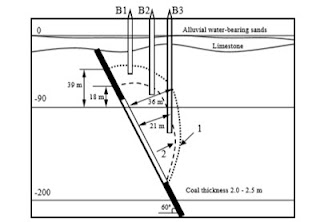
(1) Slightly fractured subzone. Only little fractures are induced in the strata. Compared to the original strata, hydraulic conductivity in this zone increases slightly. The fluid circulation loss rates in the observing borehole are less than 0.1 l/s m;
(2) Moderately fractured subzone. The strata only have partial bed separations and fractures. Hydraulic conductivity in the strata increases moderately. The circulation loss rates are between 0.1 and 1.0 l/s m;
(3) Severely fractured subzone. Most of the strata have been fractured, and the fractures are interconnected. Hydraulic conductivity in the strata increases dramatically. The circulation loss rates are greater than 1.0 l/s m.
Field observations by circulation loss measurements in boreholes while drilling have shown that the strata failure characteristics differ considerably for different inclinations of the extracted seams. For flat or slightly inclined coal seams (the dip angle, D < 30q), the profile of the water-conducting fractured zone is broad in section with extended lobes over the headgate and tailgate, as shown in Fig. 9.2. For strong rocks, the failure zone has a different characteristic, as shown in Fig. 9.3, which is that the failure zones are much higher in the vertical direction and narrower in section.
For inclined coal seams (30q
A considerable number of in-situ observations have shown that heights of strata caved and fractured zones in the overburden formation depend primarily on the lithology and strength of the overlying strata, as well as the inclination of the extracted seam. The following formulae have been obtained according to in-situ observations in thousands of longwall faces (Liu et al. 1981, Bai and Elsworth 1990, Zhang and Shen 2004).
For mining under aquifers, it is desirable to avoid the extra expense of strata dewatering. This can only be achieved when aquifers are located outside the water-conducting fractured zone. In this case, water inflow into the mine workings does not increase. When an aquifer lies within the fractured zone, but outside the caved zone, excessive groundwater discharge to the mine occurs (according to the mining experiences in China); however, the sand in the unconsolidated aquifer does not flow into the mining area. When an unconsolidated aquifer is situated within the caved zone, both water and sand can rush into the mining area, and this may even cause disastrous consequences, if the aquifer is very permeable and strongly waterbearing.
The Daliuta coal mine, affiliated with the Shenhua Group, is located in ShenFu Coalfield, Northern Shaanxi Province and on the southwestern bank of the Yellow River, Northern China (Fig. 9.7). It is one of the major coal mines in China. This coalfield consists of nearly flat-lying beds of Jurassic coal measure. The thickness of the primary coal seam, No. 2, is approximately 4 m with the roof consisting of medium-grained sandstones. The overlying coal measures are 19 to 65 m in thickness, comprising weak, weathered strata in the uppermost reaches. The bedrock is overlain by unconsolidated alluvium comprising mixed impermeable clay layers with water-bearing sands and gravels. The alluvium is generally 38 to 43.4 m in thickness, in which one aquifer underlies lowermost in the unconsolidated overburden. The total depth of cover for seam No. 2 ranges approximately from 20 to 100 m. Comprehensive mechanized longwall mining with full caving is used in the coal extraction.
The coalfield has a very dry temperate climate and is situated in the southeastern border of the Maowusu Desert. Most of the surface is covered by sand, in which little vegetation exists. The water resource is very precious in this region. Only one perched aquifer in the Quaternary alluvium overlies directly on the coal measure. Therefore, the protection of the water resource and mining safety from groundwater hazards are common concerns of both the mine operator and government.

Support and Reinforcement in the Mining Cycle

The most commonly used mesh is probably welded mesh made of approximately 5 mm thick steel wire and having 100 mm square openings. The steel wire may be galvanised or not. The alternative has been an interwoven mesh known as chain link mesh. The disadvantage of traditional chain link mesh compared with weld mesh has been the difficulty of applying shotcrete successfully through the smaller openings available. This difficulty has now been overcome in a high strength, light weight chain link mesh with 100 mm openings which is easy to handle and can be made to conform to uneven rock surfaces more readily than weld mesh.
A feature of this mesh is the fact that the intersections of the wires making up the squares in the mesh are twisted rather than simply linked or welded. Roth et al. (2004) describe static and dynamic tests on this mesh. Mesh of this type is being used successfully at the Neves Corvo Mine, Portugal, where it has been particularly successful in rehabilitating damaged excavations. Li et al. (2004) report that this mesh is being trialled by St Ives Gold, Western Australia. Tyler & Werner (2004) refer to recent trials in sublevel cross-cuts at the Perseverence Mine, Western Australia, using what a similar Australian made high strength chain link mesh. It is understood that completely satisfactory mechanised installation methods have yet to be developed.
In this symposium, Hadjigeorgiou et al. (2004) and Van Heerden (2004) discuss the use of cementitious liners to support, protect and improve the operational performance of ore passes in metalliferous mines. One of the benefits of cementitious liners is the corrosion protection that they provide to the reinforcing elements. Both papers emphasise the need to consider the support and reinforcement of ore passes on a cost-effectiveness basis taking into account the need to rehabilitate or replace failed passes. The author has had the experience of having to recommend the filling with concrete and re-boring of critical ore passes that had collapsed over parts of their lengths.
Although their use was referred to at the 1999 symposium, there have been significant developments in the use of thin, non-cementitous, spray-on liners (TSLs) since that time (e.g. Spearing & Hague 2003). These polymer-based products are applied in layers of typically 6 mm or less in thickness, largely as a replacement for mesh or shotcrete. Stacey & Yu (2004) explore the rock support mechanisms provided by sprayed liners.
The author’s experience at the Neves Corvo Mine, Portugal, is that TSLs are useful in providing immediate support to prevent rock mass deterioration and unravelling in special circumstances (Figure 2), but that they do not yet provide a cost-effective replacement for shotcrete in most mainstream support applications. In some circumstances, they can be applied more quickly than shotcrete and may be used to provide effective immediate support when a fast rate of advance is required. Recently, Archibald & Katsabanis (2004) have reported the effectiveness of TSLs under simulated rockburst conditions.
Overcoming the limitations and costs associated with the cyclic nature of underground metalliferous mining operations has long been one of the dreams of miners. More closely continuous mining can be achieved in civil engineering tunnelling and in longwall coal mining than in underground hard rock mining. Current development of more continuous underground metalliferous mining systems is associated mainly, but not only, with caving and other mass mining methods (Brown 2004, Paraszczak & Planeta 2004).
Several papers to this symposium describe developments that, while not obviating the need for cyclic drill-blast-scale-support-load operations, will improve the ability to scale and provide immediate support and reinforcement to the newly blasted rock. Jenkins et al. (2004) describe mine-wide trials with hydro-scaling and in-cycle shotcreting to replace conventional jumbo scaling, meshing and bolting at Agnew Gold Mining Company’s Waroonga mine, Western Australia. Neindorf (2004) also refers to the possibility of combining hydro-scaling with shotcreting to develop a new approach to continuous ground support in the development cycle at Mount Isa. These developments form part of the continuous improvement evident in support and reinforcement practice in underground mining.
As was noted at the 1999 symposium, although backfill has been used to control displacements around and above underground mining excavations for more than 100 years, the great impetus for the development of fill technology came with the emergence of the “cut-and-fill era” in the 1950s and 60s (Brown 1999a). It was also noted that fill did not figure prominently in the papers presented to that symposium. A few years earlier, paste fill made from mill tailings and cement and/or other binders, had been developed in Canada (Landriault 2001). Since that time, the use and understanding of paste fill have increased dramatically, so much so that Belem et al. (2004b) suggest that it is “becoming standard practice in the mining industry throughut the world”.
Cemented paste fill is now used with a range of mining methods including sublevel open stoping, cut-and-fill and bench-and-fill. In some applications, it is necessary that unsupported vertical paste fill walls of primary stopes remain stable while secondary stoping is completed. In common with Landriault (2001) and Belem et al. (2004a), the author has had success using the design method proposed by Mitchell (1983). A particular requirement in some applications is to include enough cement to prevent liquefaction of the paste after placement (Been et al. 2002).
In two papers to this symposium, Belem et al. (2004a, b) discuss a range of fundamental and applied aspects of the use of cemented paste fill in cut-and-fill mining generally, and in longhole open stoping at La Mine Doyen, Canada. Varden & Henderson (2004) discuss the use of the more traditional cemented rock fill to fill old underground mining voids at the Sons of Gwalia Mine, Western Australia.

Andi Arief Wanti-wanti Ridwan Kamil Soal Jejaring Peternak China Di Kawasan Gunung Padang

GELORA.CO - Gubernur Jawa Barat, Ridwan Kamil diingatkan soal keberadaan usaha peternakan ayam petelur oleh jejaring peternak China di kawa...